You didn’t do anything unusual yesterday. No heavy lifting, no long drive, no new workout. Yet you woke up with a stiff neck, an achy lower back, or a shoulder that won’t fully lift. The culprit might not be anything you did during the day at all — it’s how you spent the eight hours before you even opened your eyes.
Your sleeping position quietly shapes the pressure on your spine, joints, and muscles every single night. Over weeks and months, that pressure adds up into patterns you can actually recognize. Here’s what your favorite position is telling you, and what you can do about it.
Back Sleeping: Generally Spine-Friendly, But Not Pain-Proof
Back sleeping is often held up as the gold standard, and for good reason. Lying flat distributes your weight evenly and keeps your spine close to its natural curve, which is why it’s frequently recommended for people managing lower back pain.
That said, “spine-friendly” doesn’t mean “ache-free.” If you wake up with a sore lower back despite sleeping on your back, the usual suspect is an unsupported lumbar curve or a pillow that tilts your head too far forward or back. A pillow with too much loft pushes your chin toward your chest all night, straining the neck even though your spine looks aligned everywhere else.
Common complaints from back sleepers
- Tight lower back, especially for those with a pronounced lumbar curve
- Snoring or a dry mouth, since this position can narrow the airway
- A stiff neck if the pillow is too thick or too flat
Side Sleeping: Easy on the Spine, Harder on Shoulders and Hips
Side sleeping is the most common position among adults, and it has real advantages for spinal alignment and breathing. The challenge is that your head, shoulder, and hip are no longer in a flat line — there’s a gap between your ear and your mattress, and your top leg has nothing underneath it.
If that gap isn’t filled, your neck bends sideways for hours, which is a frequent reason people wake up with a stiff neck. Meanwhile, an unsupported top knee can rotate your hips and pull on your lower back. Getting the pillow height right matters more for side sleepers than for any other position — too low and your neck sags, too high and it kinks upward.
What usually helps
A pillow with enough loft to fill the space between your ear and shoulder keeps your cervical spine level. This is exactly the gap the Nekrelief Pillow is designed to support, with ergonomic contouring built for side and back sleepers who need that extra fill without added bulk. If you haven’t settled on the right height yet, our guide to pillow loft for side sleepers walks through how to measure what you actually need.
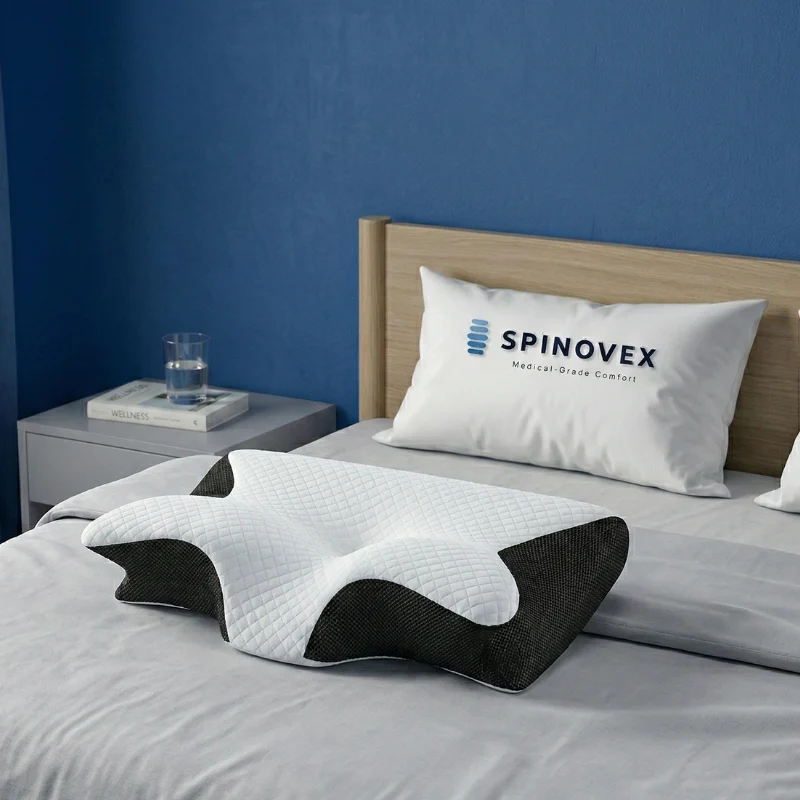
Side sleepers also benefit from support between the knees. Letting your top leg drop forward twists your pelvis and lower spine out of alignment, which is a common hidden cause of morning hip and back stiffness. A simple Knee Pillow placed between the knees keeps the hips stacked and the spine more neutral through the night.
Stomach Sleeping: The Position That Works Against You
Stomach sleeping flattens your natural lower back curve and forces your head to rotate fully to one side for hours at a time. That combination puts strain on both ends of your spine at once, which is why this position is so often linked to both neck and lower back discomfort.
If you’re a committed stomach sleeper, you’re not alone, and you don’t have to give it up overnight. Small adjustments — like using a very thin pillow or none at all, and placing a flatter cushion under your hips — can reduce some of the strain. For a fuller breakdown of how to transition more comfortably, see our guide on switching away from stomach sleeping.
Combination Sleepers: Why You Wake Up Different Every Day
Most people aren’t loyal to one position all night. You might fall asleep on your back, roll onto your side by midnight, and wake up on your stomach. This is completely normal, but it does mean your support needs change as you move.
Combination sleepers generally do best with a pillow that adapts across positions rather than one built for a single posture. Memory foam that contours as you shift, instead of flattening out, is particularly useful here since it keeps adjusting to whichever position you land in.
A short wind-down stretch before bed can also help loosen the muscles that tend to tighten regardless of how you end up sleeping. Our 5-minute neck stretch routine works just as well as an evening reset.
Matching Your Sleep Setup to Your Position
Once you know your dominant position, the solution is usually about support, not willpower. A few practical pairings:
- Back and side sleepers often do well with a contoured pillow like the Nekrelief Pillow, which is designed to cradle the neck’s natural curve in either position.
- Side sleepers can reduce hip and lower back strain by adding a Knee Pillow between the knees.
- Anyone sensitive to light, especially if a partner reads or an early sunrise disrupts your sleep, may find a Silk Eye Mask a simple addition to a better wind-down routine.
If you’re building out a full setup, keep in mind that free US shipping applies to orders over $100, so bundling a pillow with a knee pillow or eye mask can make more sense than ordering separately. Every Spinovex pillow also comes with a 100-night trial, which gives your body real time to adjust rather than judging comfort after one night.
For a deeper look at how posture and alignment interact across the whole night, our guide to sleep posture and spinal alignment is a good next read.
Frequently Asked Questions
Can changing my sleeping position actually reduce pain?
For many people, yes. Adjusting position and improving support around the neck, hips, and knees can reduce the mechanical strain that contributes to morning stiffness. That said, sleep posture is one piece of a larger picture that includes mattress quality, activity level, and overall health.
Is it bad to switch positions during the night?
Not necessarily. Shifting position is a normal, healthy habit — it’s often your body’s way of relieving pressure before it builds up. The goal isn’t to stay frozen in one position, but to make sure each position you land in has adequate support.
Which sleeping position is best if I have both neck and back pain?
Back sleeping with proper pillow support under the head and knees is generally the most balanced option for managing both areas at once, since it keeps the spine close to neutral. Side sleeping with a supportive pillow and a cushion between the knees is a close second.
When should I see a doctor about pain from sleeping?
If your pain is severe, radiates down an arm or leg, includes numbness or tingling, or doesn’t improve after a few weeks of adjusting your sleep setup, it’s time to check in with a doctor or physical therapist. Persistent pain deserves a proper evaluation rather than guesswork.
Listen to What Your Mornings Are Telling You
Your sleeping position isn’t random — it’s a habit your body has settled into, and it leaves clues every morning in the form of a stiff neck, a sore back, or an ache you can’t quite place. Paying attention to those clues is the first step toward sleeping, and waking up, a little better.
If you’re ready to give your neck and spine more support, take a look at the Nekrelief Pillow and explore the rest of the Spinovex lineup — backed by a 100-night trial, so your body has time to tell you if it’s working.
This article is for informational purposes only and is not medical advice. If you experience persistent, severe, or radiating pain or numbness, please consult a healthcare professional.